
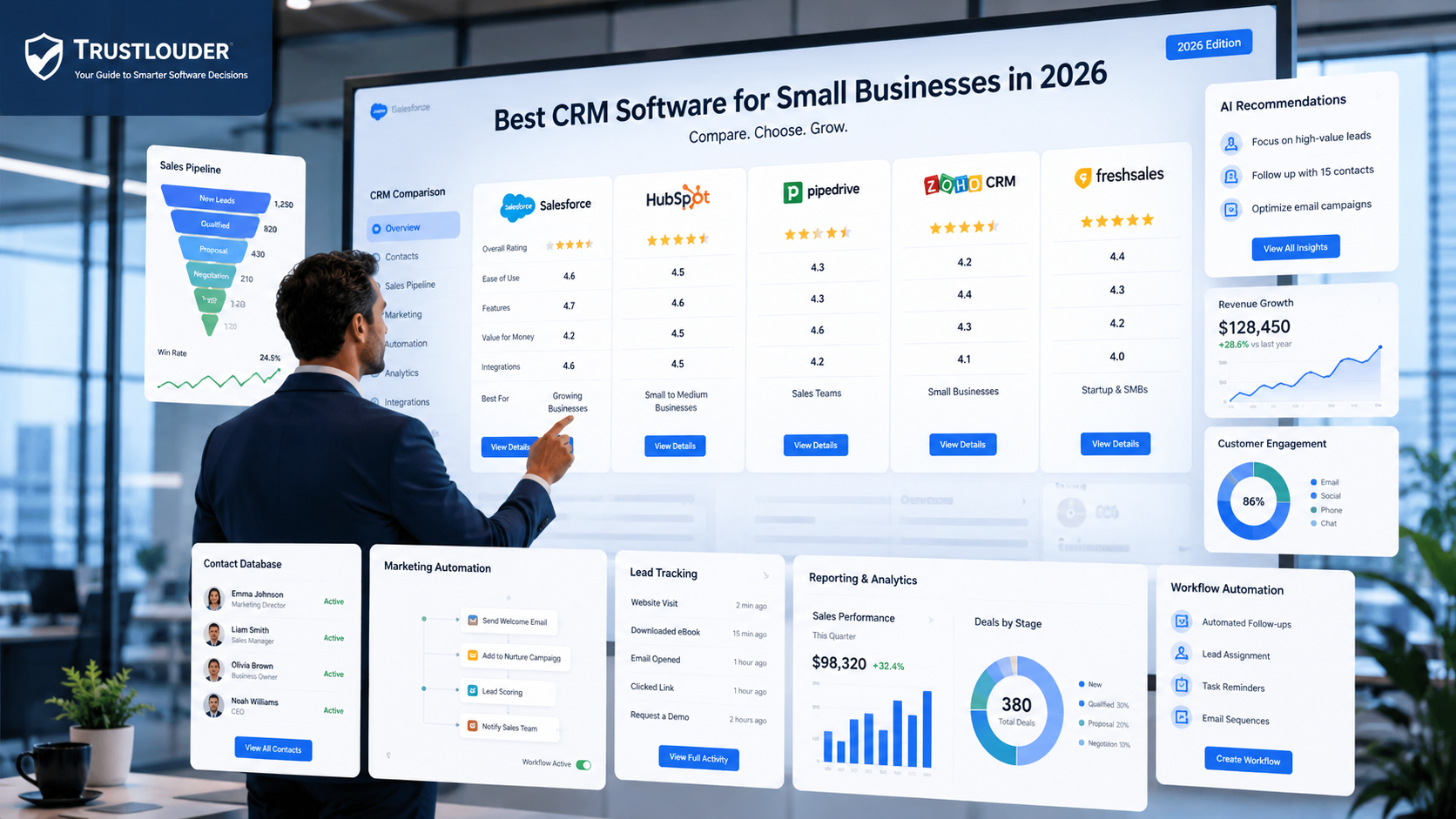
Finding the best CRM software for small businesses is no longer optional in today’s competitive market. Whether you’re managing a startup, growing service business, or expanding sales team, the right Customer Relationship Management (CRM) platform can help you organize leads, automate follow-ups, improve customer relationships, and increase revenue.
But with dozens of CRM tools available, choosing the right solution can feel overwhelming.
To help you make an informed decision, we’ve compared the leading CRM software platforms based on features, ease of use, automation capabilities, scalability, pricing, and overall value for small businesses.
Quick Answer: Which CRM Software is Best?
If you’re looking for the best CRM software for small businesses in 2026:
- Zoho CRM – Best Overall Value
- HubSpot CRM – Best Free CRM
- Salesforce – Best for Enterprise Growth
- Pipedrive – Best for Sales Teams
- Freshsales – Best for Customer Engagement
The best choice depends on your business size, budget, and sales process.
What is CRM Software?
CRM software helps businesses manage customer interactions, track leads, organize contact information, automate sales activities, and improve customer retention.
Instead of relying on spreadsheets and manual follow-ups, CRM systems centralize all customer data in one platform, making it easier to manage relationships and close more deals.
Benefits of CRM Software for Small Businesses
Implementing CRM software can provide several advantages:
Improved Lead Management
Track every lead from first contact to final sale.
Better Customer Relationships
Store communication history and customer preferences in one place.
Increased Sales Productivity
Automate repetitive tasks and focus on selling.
Improved Team Collaboration
Give sales, marketing, and customer support teams access to shared customer information.
Actionable Business Insights
Use reports and analytics to identify growth opportunities.
Best CRM Software for Small Businesses
1. Zoho CRM – Best Overall CRM
Zoho CRM combines affordability, automation, customization, and scalability, making it one of the most popular CRM solutions for small businesses.
Key Features
- Lead management
- Sales automation
- Workflow automation
- Email marketing integration
- AI-powered sales assistant
- Advanced reporting
Pros
- Affordable pricing
- Excellent automation
- Large integration ecosystem
- Highly customizable
Cons
- Advanced features require setup time
Best For: Small and growing businesses.
2. HubSpot CRM – Best Free CRM Software
HubSpot CRM is known for its user-friendly interface and generous free plan.
Key Features
- Contact management
- Email tracking
- Live chat
- Sales pipelines
- Marketing automation
- Reporting dashboards
Pros
- Free version available
- Easy to use
- Strong marketing tools
Cons
- Costs increase as businesses scale
Best For: Businesses focused on inbound marketing.
3. Salesforce – Best Enterprise CRM
Salesforce remains one of the most powerful CRM platforms in the world.
Key Features
- Sales automation
- AI-powered insights
- Opportunity management
- Custom workflows
- Enterprise reporting
Pros
- Extremely scalable
- Industry-leading features
- Massive integration marketplace
Cons
- Expensive for small businesses
Best For: Rapidly growing companies.
4. Pipedrive – Best CRM for Sales Teams
Pipedrive focuses on helping sales professionals manage pipelines and close deals more efficiently.
Key Features
- Visual sales pipeline
- Activity reminders
- Workflow automation
- Lead management
- Reporting tools
Pros
- Easy implementation
- Excellent sales visibility
Cons
- Limited marketing features
Best For: Sales-driven businesses.
5. Freshsales – Best CRM for Customer Engagement
Freshsales combines CRM capabilities with communication and customer engagement tools.
Key Features
- Lead scoring
- Built-in phone
- Email tracking
- Automation workflows
- Customer insights
Pros
- User-friendly
- Strong communication features
Cons
- Premium plans required for advanced features
Best For: Businesses prioritizing customer communication.
CRM Software Comparison Table
| CRM Software | Best For | Free Plan | Automation | Ease of Use |
|---|---|---|---|---|
| Zoho CRM | Overall Value | Yes | Excellent | Good |
| HubSpot CRM | Beginners | Yes | Excellent | Excellent |
| Salesforce | Enterprises | No | Advanced | Moderate |
| Pipedrive | Sales Teams | No | Good | Excellent |
| Freshsales | Engagement | Yes | Good | Good |
How to Choose the Best CRM Software
Before purchasing CRM software, consider:
Your Budget
Choose software that delivers value without exceeding your budget.
Business Growth Plans
Select a platform that can scale with your business.
Automation Requirements
Prioritize tools that automate repetitive sales tasks.
Integration Needs
Ensure compatibility with email, accounting, marketing, and collaboration tools.
User Experience
Simple software drives better adoption across teams.
Frequently Asked Questions
What is the best CRM software for small businesses?
Zoho CRM is often considered one of the best CRM solutions due to its affordability, automation features, and scalability.
Is there free CRM software available?
Yes. HubSpot CRM and Zoho CRM offer free plans suitable for small businesses and startups.
Which CRM is easiest to use?
HubSpot CRM and Pipedrive are widely recognized for their intuitive interfaces.
Can CRM software increase sales?
Yes. CRM software improves lead management, automates follow-ups, and provides insights that help businesses close more deals.
What CRM is best for startups?
Zoho CRM and HubSpot CRM are excellent choices for startups due to their flexible pricing and ease of use.
Final Verdict
Choosing the best CRM software depends on your business goals, sales processes, and budget. For most small businesses, Zoho CRM offers the best balance of affordability, features, and scalability. However, HubSpot CRM, Salesforce, Pipedrive, and Freshsales are also excellent options depending on your specific needs.
Investing in the right CRM today can help your business improve customer relationships, streamline operations, and drive long-term growth.